 |
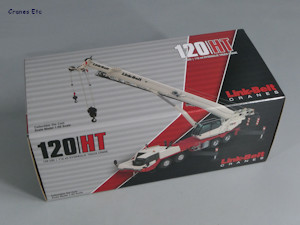
| Link-Belt
box. |
 |
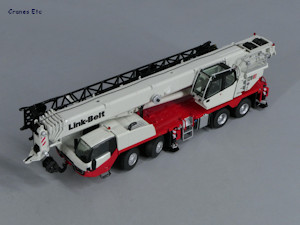 |
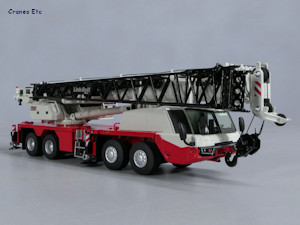
| On the road. |
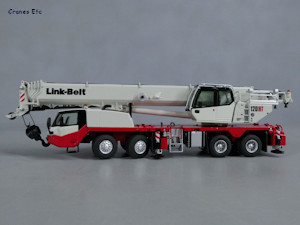 |
| Profile. |
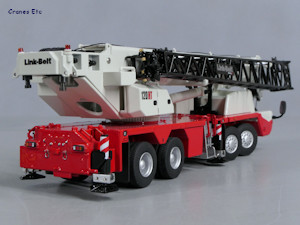 |
| Steering front
axles. |
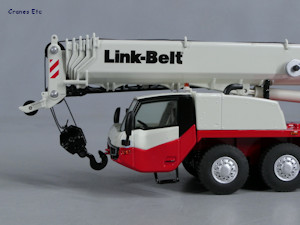 |
| Large hook on
the block. |
|
|
 |
| Nice pads on
the outriggers. |
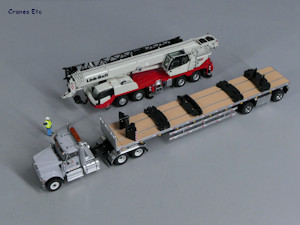 |
| Convoy. |
 |
| Lifting the
load plate. |
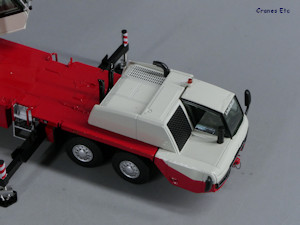 |
| Engine area. |
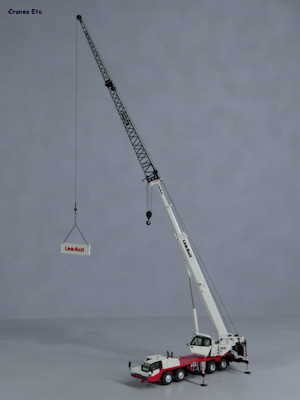 |
| Fly jib
attached. |
|
The Link-Belt 120|HT Hydraulic Truck Crane is a 4-axle
road crane with a maximum capacity of 120 US tons.
Packaging
The model comes in a Link-Belt branded box, with the model
contained within two trays with the parts wrapped.
There were no defects or missing parts on the review
model.
A coloured instruction leaflet is provided, which is
mainly pictorial. This describes most of the the
assembly and features of the model although there are no
reeving diagrams.
There is a little information about the real crane on
the box, together with information about the model.
It states the boom cylinder is diecast but it is not.
Detail
The chassis has the transmission
detailed but the steering axles are not linked. The
wheels have different tyres front and rear and the wheels are detailed.
There are soft rubber mud flaps.
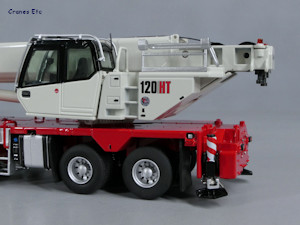
The single person carrier cab has a Link-Belt graphic
and reasonable detail inside. A loop at the front allows tying on
the hook blocks during transport. Behind the cab, there
is a mesh grille. At the back there is some nice
detailing of grab rails, loops and lights. There
are no license plates as this is a generic model.
The outrigger beams are two-stage metal, with chevron graphics. The outrigger pistons
have visible screw threads, with detailed pads on the
bottom.
The crane body sits on a large toothed slewing ring and the
operator's cab is nicely modelled with the grab rails being plastic.
The crane body is
detailed with sharp graphics. The
hand rails are metal and there are small beacon lights.
There are no hydraulic hoses modelled.
The counterweight made up of a number of
different metal plates and parts.
The main boom ram has a plastic jacket with an excellent
colour match. There is an enlarged moulding that
accommodates a locking grub screw.
The boom has some nice detailing
including tiny rope guides. At the boom head
axles act as connection points for the fly jib and this
represents the fixing points of the real crane. However they
are loose and can go out of position sideways easily.
A spooling drum is fitted to one side of the boom.
The telescope sections are engineered well. The
top section is very thin because of the thicknesses of
the telescope sections.
The fly jib is made in two separable metal parts.
They connect with tiny brass
nuts and bolts for which tools are supplied. The
ratchet system for setting offset angles is detailed but
non-functional.
All sheaves on the model are black metal. White
plastic ones would have been a closer match to the real
crane.
Two hooks are supplied. One is a single line block and
the other is multi sheave for heavy lifting.
A metal Link-Belt load plate is included.
Features
The two front axles can be independently
steered although it would have been better if they were
linked. All axles have working suspension with good
movement.
The outriggers pull out, and the pistons screw down. No
spreader plates are included but the range of travel supports
the model wheels-free. There is a pull down
outrigger under the carrier cab.
The crane rotates well.
The counterweight system is very flexible. During self-ballasting
the counterweight can be placed on the
carrier deck. The entire counterweight is removable to
minimise axle loads during transport.
Attaching the counterweight is
done by screwing down and interlocking two rams, which
can then be screwed back up to secure the counterweight. Different configurations
of counterweight can be displayed.
The plastic boom ram has a locking system using a grub
screw and key. It appears that is designed to be
operated only at certain extensions as the piston has
indentations. Unfortunately the spacing of these does
not allow the boom angle to be steep enough. It is
also not as good or reliable as higher quality metal ram
jackets.
The boom has two locking points on the top side of each telescopic section.
The fly jib can be carried on the side of the boom
although it does not fit well. It attaches to the
boom end using brass nuts and bolts and can be set at
full length or folded half length.
The operator's cab tilts, and the handrail on the crane
can be folded for transport mode.
Quality
This a heavy model, with a high metal
content
The paintwork is very good and the applied graphics are very
sharp.
Price
It is fully priced.
Overall
This is a good looking model of the 120|HT. The
detailing is generally fine however some aspects of the
functionality are not to the best of modern standards,
particularly the boom ram.
Footnotes
The model was first announced at Bauma 2025.
|
|
|
|
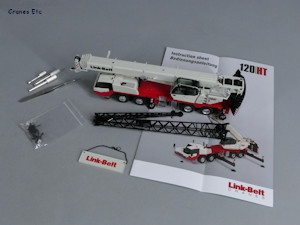 |
| Out of the box. |
 |
| Fly jib did not
sit quite right on the review model. |
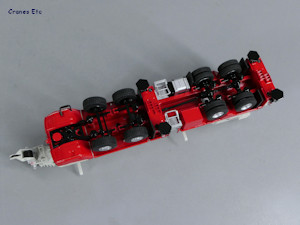 |
| Underneath. |
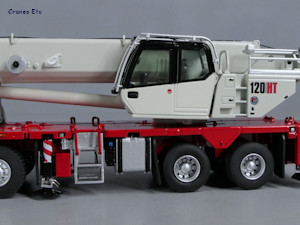 |
| Road wheels and
tyres.
|
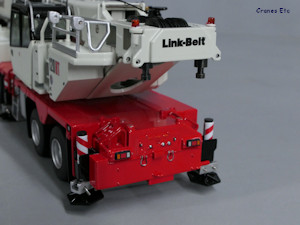 |
| Nice detailing
at the back. |
|
|
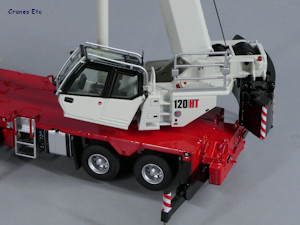 |
| Tilting cab. |
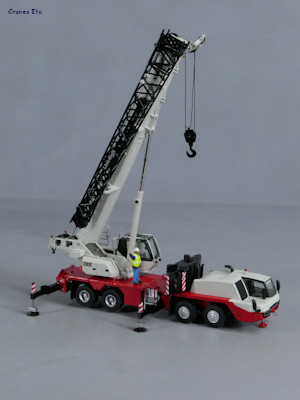 |
| Self-ballasting. |
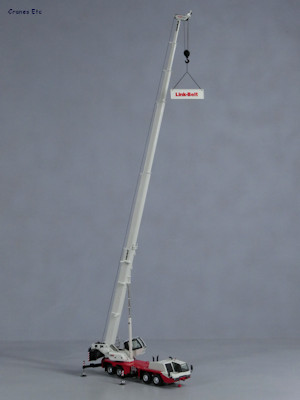 |
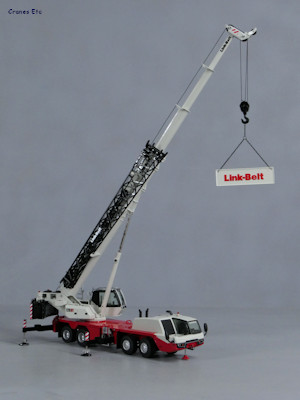
| Boom extended.
The fly jib will not sit on the side of the boom
properly when it is at a steep angle. The model's
boom piston was modified to achieve the angle shown. |
|