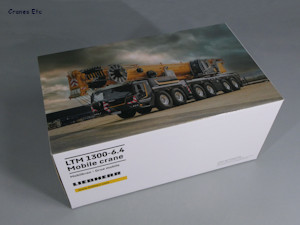
 |
| The large
box. |
 |
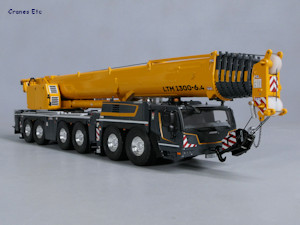 |
| On the
road.. |
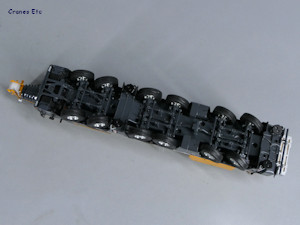 |
| Detailed
chassis. |
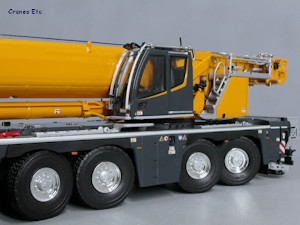 |
| Tiny
graphics are excellent. |
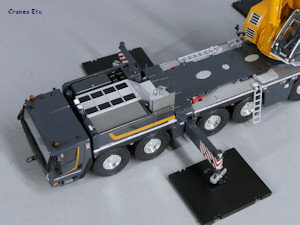 |
| High detail
in the engine area.
|
|
|
 |
|
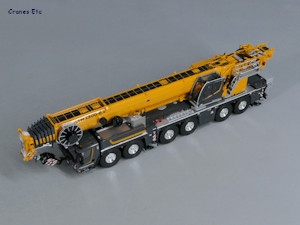
Travelling mode. |
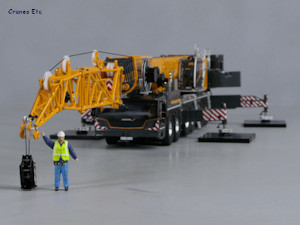 |
| Posed with
a short fly jib. |
 |
|
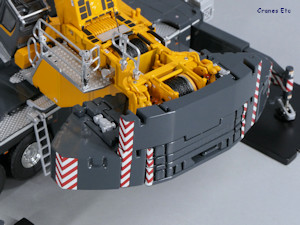
Counterweight is made of many parts. |
 |
| Deck
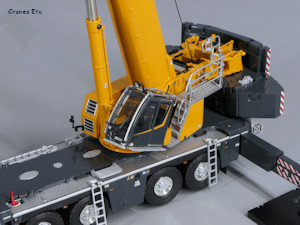
ladders lowered and tilting cab. |
 |
| Fly jib
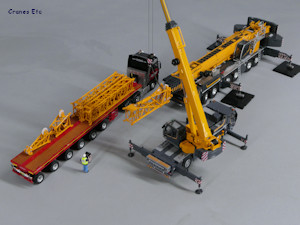
being assembled. |
 |
|
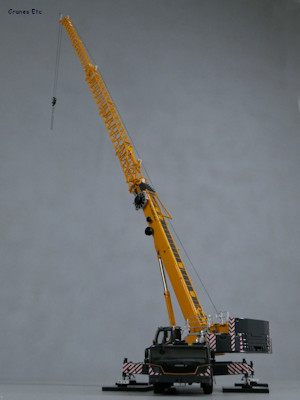
Maximum fly jib. |
 |
|
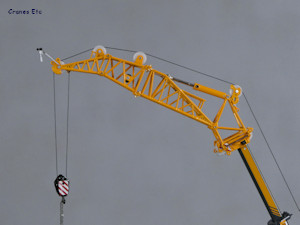
Nice fly jib with adjustable hydraulic system. |
|
The Liebherr
1300-6.4 mobile crane has a maximum capacity
of 300 tonnes.
Packaging
The model comes in a
Liebherr-branded
box design and is held within trays
which are held together with plastic clips. The parts
are wrapped. The fly jib comes in separate
packaging inside the box presumably as future company
livery versions may not include it.
There were no missing parts or defects on the review
model.
The model has an instruction manual which is
disappointing by modern standards. There is no
parts list and it is not obvious where all parts get
fitted. There is very little information to assist
an inexperienced collector.
Detail
The chassis is very highly detailed with replicated
transmission and suspension systems.
The tyres are very good with a fine tread pattern and branding moulded in the sidewalls. The wheels have
different hubs for driven and non-driven axles.
The carrier cab has beacon lights and roof aerials, and
at the front there is a hitch for tying a hook whilst
travelling. There is a dummy number plate. The door steps are textured and
the door handles are highlighted. Interior detailing is
also high quality.
Behind the carrier cab the engine area is highly detailed
with textured surfaces and mesh
grilles. Tiny graphics add detail throughout.
Black skirts sit above the wheels and the carrier deck
has a variety of access ladders. At the rear is a
storage box with timbers inside.
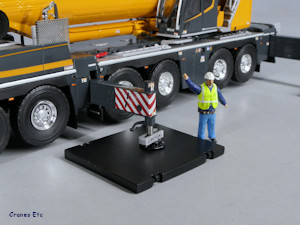
The outrigger pads have a working pinning mechanism
which allows the pads to be fixed in an offset way so
they are within the footprint of the crane when the
outrigger beams are retracted. The
pistons are smooth with the screw mechanism being
internal so they look realistic. Tiny graphics add to
the authentic look. Metal spreader plates are
included and they have lifting points. The profile
of the outriggers under load is very good.
The crane cab has metal handrails with a textured walkway. The interior detail is very
good.
Underneath the crane body the
toothed slewing ring is visible. The crane body also
has a high level of detailing with small graphics, metal handrails and ladders, and textured surfaces.
The counterweight consists of a number of parts.
Detailing around the main winch is of a very high
standard with hoses and intricate small parts.
The main boom ram is a very nice metal part with
detailing in the ram jacket. The boom
sections have very thin walls which provide a realistic
profile when not fully extended, but there is too much
curvature in the boom with each section at maximum
extension.
Detailing on the lowest boom section includes spooling
drums, and pipework within the casting. The boom head
is also very good with fine detailing and plastic
pulleys which replicate the ones used on the real crane. A safety hoist
cut-off chain and block hangs from the boom top, and
there is a realistic tying-off point and wind gauge
also.
The fly jib is of very nice lightweight metal
construction. The hydraulic ram for the adjustable
jib has a metal jacket.
Two metal hook blocks are included (single and triple
sheave), and they are very
nice quality.
Features
All axle pairs have stiff sprung suspension. Each axle also steers with
some very good steering angles being possible.
However, the rolling characteristics are not so good as
not all wheels are fully grounded and some looseness in
the steering of some axles does not help.
Handrails on the crane body can be folded up from the
transport mode. Access ladders can be folded
down from the carrier deck.
The outrigger beams can extended and the pads lowered, and feature
an excellent pad pinning feature with fine wire clips.
The range of downward travel on the pistons is very
good, and the model can be supported wheels-free.
The operator's cab can be tilted and it holds a pose
well. It has a foot platform which can be pulled
out.
The crane rotates smoothly.
The counterweight system can be mounted on the carrier
deck during self-assembly. Locating tabs can be
raised up to aid the positioning. Different
counterweight configurations can be used.
Raising the boom is easy with the locking mechanism on
the main boom ram using a key to tighten grub screws
on the jacket top.
Telescoping the boom is smooth and easy with a spring lock
to clip each boom section. It is possible to lock
each section at approximately 50%, 90% and 100% extension.
A key is also used to operate the main winch. It has a
push-in action with a positive brake, and it works
well.
Different hook blocks can be reeved, and they each have
rotating hooks.
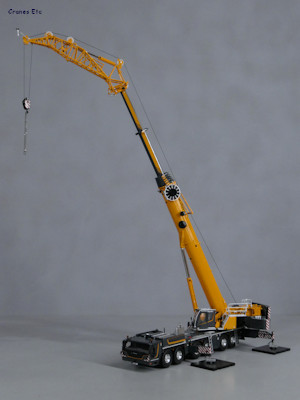
The fly jib can be erected in numerous
configurations and the hydraulic ram can be used to set
different offset angles.
Quality
This is a high quality model which is made well, and the
parts fit together well.
The paintwork and graphics are generally excellent.
Price
It is decent value for a large crane model.
Overall
This is a highly detailed crane model by WSI with an
exceptional use of small graphics. Most of the
functionality is to a high standard too, and a plus
point is the many different configurations that are
possible.
Footnotes
The model first appeared in Liebherr
yellow at the Bauma exhibition in April 2025. |
|
|
|
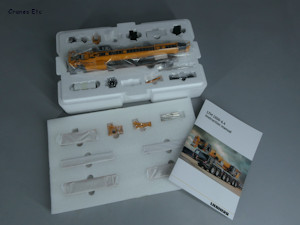 |
| The trays
and manual. |
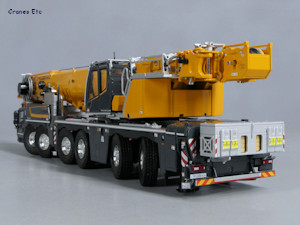 |
| Storage box
at the back. |
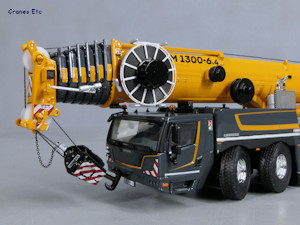 |
| Large
spooling drum. |
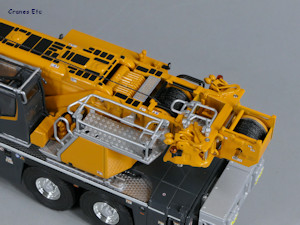 |
| Folding
handrails.. |
 |
|
Detailed outriggers. |
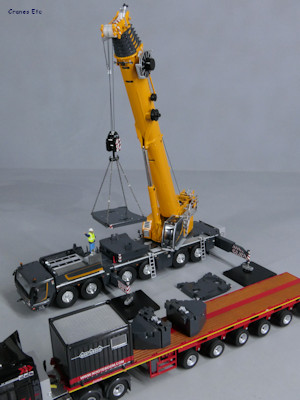 |
| Self
ballasting. |
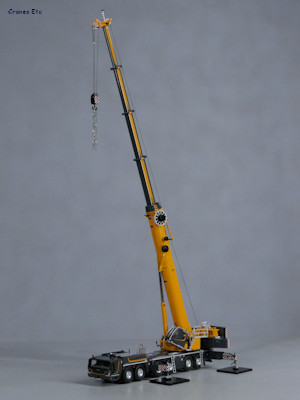 |
| Very nice
boom sections. |
 |
|
Jib set at an offset. |
|
|
 |
|
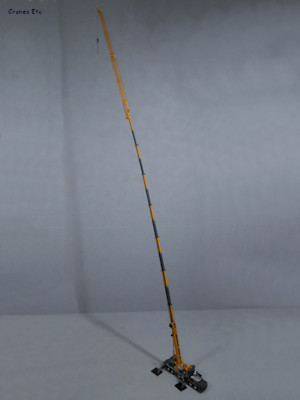
Similar to a TNZF configuration. The slightly
curved profile of the boom at approximately 90%
extensions is much better than at 100%.
|
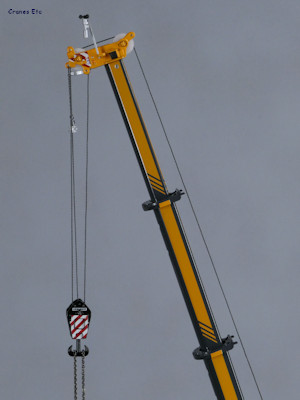 |
| Thin walled
boom sections. |
|
|